

If you have ever been involved in selecting or deploying an antenna solution, chances are you have come across the term VSWR, short for Voltage Standing Wave Ratio. It sounds technical, and in some circles, it is treated as one of the most important numbers on a datasheet. But what does it mean, and how much should it influence your decisions?
This article breaks it down in plain language, so you can have more informed conversations with customers, compare products with confidence, and understand what good antenna specifications really look like.
Think of a wireless signal travelling from your router through a cable to your antenna. In an ideal world, every bit of that signal would reach the antenna and be radiated into the air. In practice, some of that signal bounces back toward the router if the antenna and the cable are not perfectly matched in terms of how they handle the signal, a property called impedance.
VSWR captures this behaviour. Mismatch loss occurs when part of the transmitted signal is reflected back due to impedance mismatch. VSWR is simply the ratio that describes how much of the signal is being reflected versus how much is being transmitted. A perfect score would be 1:1, meaning no reflection at all. In practice, antennas always fall somewhere above that.
The natural follow-up question is: how much does this actually cost you in terms of performance?
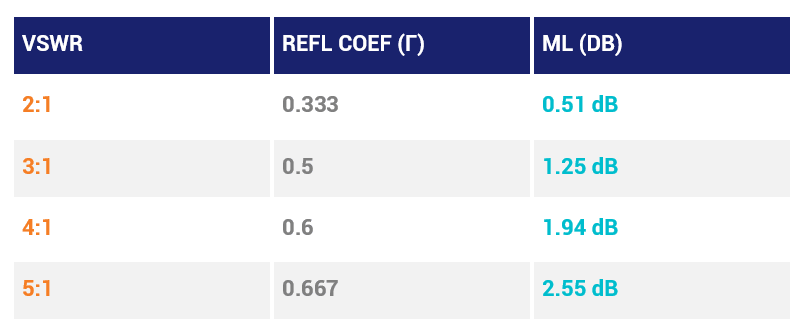
The numbers tell a reassuring story. Even at a VSWR of 2:1, the mismatch loss is only around 0.51 dB. At 4:1, that loss grows to approximately 1.94 dB, which is still modest compared to typical antenna gain variations.
To put that in everyday terms, a signal loss of around 2 dB is unlikely to be noticeable to an end user in a real deployment. It is far outweighed by factors like antenna placement, cable quality, and the environment around the installation.
It is also worth noting that modern cellular and Wi-Fi routers operate at far lower power levels than older radio equipment and are far more tolerant of VSWR. Modern routers tolerate high VSWR without issue, even an infinite VSWR caused by an open circuit. The concern is not damage to the equipment; it is simply managing a modest and predictable level of signal loss.

Here is something that often surprises people: designing an antenna for an extremely low VSWR is not always the right goal.
Designing for ultra-low VSWR of less than 2:1 reduces overall efficiency and gain by as much as 3 to 6 dB. Accepting a modest mismatch loss in the range of 0.5 to 2.5 dB allows the antenna to achieve higher overall gain.
Since modern routers tolerate high VSWR without damage, performance rather than safety is the key consideration in antenna design today.
In other words, chasing a perfect VSWR number on paper can mean sacrificing the performance that matters in the field. A well-engineered antenna balances both, and the result is better real-world connectivity, not just a more impressive-looking specification.
This is very much in line with how POYNTING approaches product development. POYNTING does not chase superficially impressive specifications but instead differentiates its products by designing for superior overall connectivity using a holistic design approach.
Understanding VSWR also helps you evaluate antenna datasheets more critically, because not all manufacturers report their figures the same way.
POYNTING gain measurements always include mismatch loss at the antenna feedpoint, making specifications reliable, trustworthy, and detailed. Competitors may exclude these losses, producing gain figures that look better than reality. While not technically incorrect, this approach is misleading.
When you compare two antennas side by side and one appears to offer higher gain, it is worth asking whether that figure accounts for mismatch loss. If it does not, you may be making a decision based on data that does not reflect how the antenna will perform once it is installed.
POYNTING is built on a foundation of trustworthiness, with results on datasheets coming from real tests, not simulations. That means when you recommend or specify a POYNTING antenna, you are working from a number you can trust.
A common question from sales teams and system integrators is: at what point should VSWR become a concern?
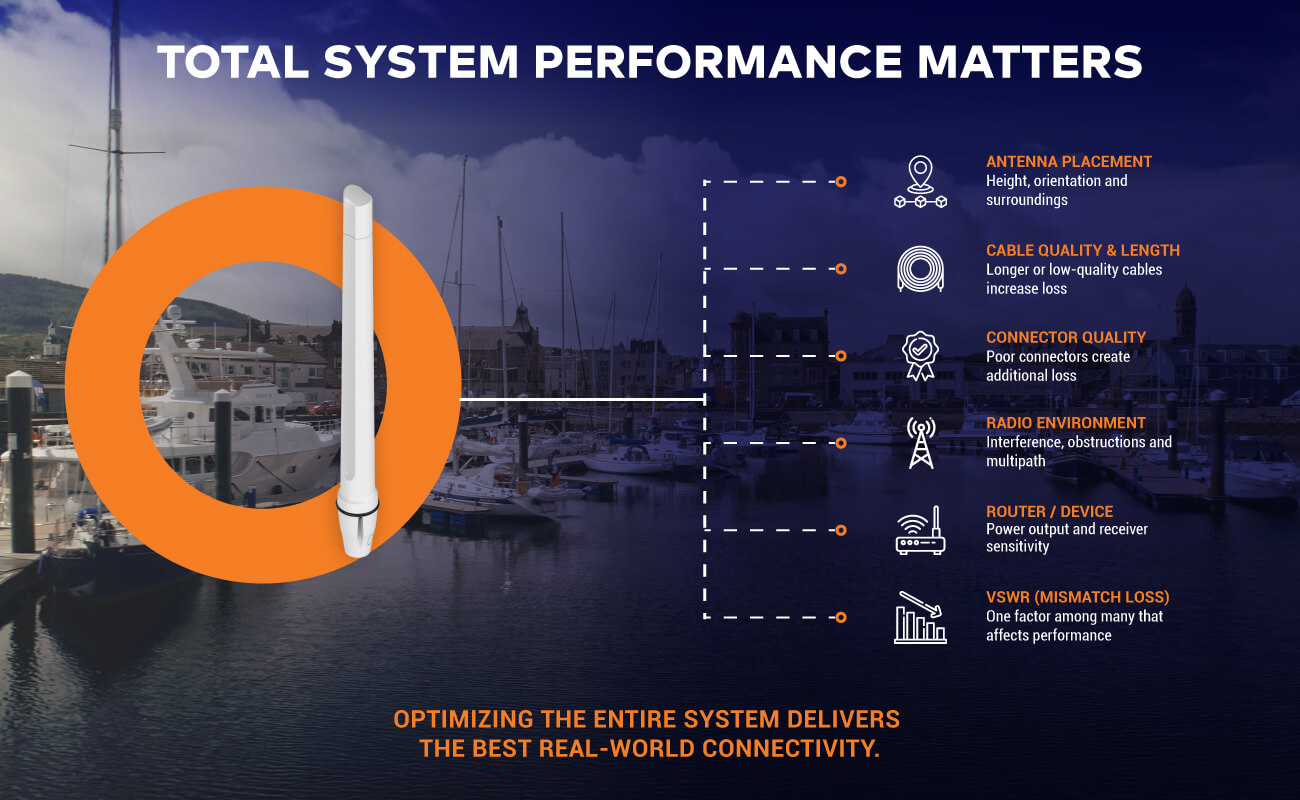
The practical answer is that VSWR becomes relevant when signal loss compounds with other losses in the system, such as long cable runs, connector quality, or a challenging radio environment. Mismatch losses are modest and manageable in modern deployments and gain specifications that already account for VSWR effects give you a complete and honest picture of antenna performance.
If a customer asks why one antenna has a higher VSWR than another, the conversation should focus on total system performance rather than a single number. A higher VSWR paired with a well-engineered gain figure is often the better choice. A lower VSWR paired with reduced gain may feel reassuring on paper but underperform where it counts.
VSWR matters, but it needs to be understood in context. It is one part of a broader performance picture, and the way it is reported on a datasheet can make a significant difference to how you interpret the data.
POYNTING's commitment to honest, reliable, and detailed specifications ensures customers can trust our data sheets to reflect real-world antenna performance. That transparency is not just a quality standard; it is a competitive advantage you can communicate with confidence to every customer you work with.
When you specify a POYNTING antenna, you are not just selecting a product. You are selecting a solution backed by engineering integrity, where the numbers on the page reflect what happens in the field.